Thummerer, da Vilmos a Tamás: l’eredità costruita a Eger
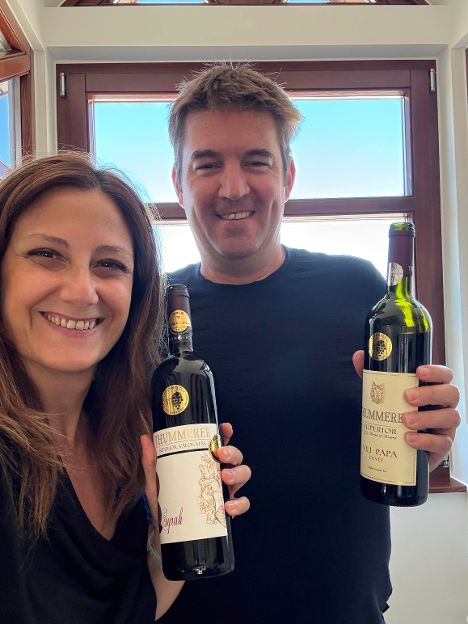
Nel 1984 l’Ungheria era ancora una Repubblica Popolare, János Kádár governava il Paese da quasi trent’anni e il vino, come buona parte dell’economia, portava addosso le conseguenze di un sistema che alla proprietà privata aveva sostituito cooperative e aziende di Stato.
È in questo contesto che comincia la storia della famiglia Thummerer a Eger.
Vilmos Thummerer non eredita una cantina. Suo padre è un forestale e il legame familiare con la terra precede quello con la vite. Dopo gli studi in viticoltura e frutticoltura, Vilmos lavora, mette insieme le risorse necessarie per avviare un’attività propria e si dedica anche alla coltivazione di fiori recisi in serra. Il vino non è, dunque, la prosecuzione di un patrimonio già esistente, ma una scelta.
Nel 1984 arrivano i primi vigneti e due piccole cantine a Eger. Sono gli inizi di un’azienda che nel giro di pochi anni avrà bisogno di altri spazi e li troverà a Noszvaj, pochi chilometri più a est.
Nel 1991 la famiglia acquista qui una proprietà sotto la quale esiste già una grande cantina scavata a mano nel tufo. Circa duemila metri quadrati di gallerie realizzate tra la fine dell’Ottocento e l’inizio del Novecento, quando quegli ambienti erano destinati alla cantina padronale di una grande tenuta.
Il passaggio da Eger a Noszvaj è tutt’altro che confortevole. Nei primi tempi Vilmos e la famiglia vivono in una roulotte sistemata nella proprietà. Dopo un inverno trascorso in quelle condizioni, si trasferiscono temporaneamente in un’abitazione scavata nella roccia, mentre viene completata la casa. Sono dettagli che oggi sorprendono, soprattutto osservando le dimensioni raggiunte dalla Thummerer: cento ettari di vigneto di proprietà e una cantina sotterranea che nel 2004 viene ampliata con altri 2.200 metri quadrati scavati nel tufo. Ma servono soprattutto a mettere nella giusta prospettiva la parola “eredità”. Perché quella ricevuta da Tamás Thummerer non era stata, a sua volta, ereditata dal padre.
Vilmos l’aveva costruita.
Nel 1995 viene nominato Wine Producer of the Year in Ungheria. Nel 2011 è la Thummerer a ricevere il titolo di Winery of the Year. Nel mezzo ci sono quasi trent’anni durante i quali il nome della famiglia si lega progressivamente alla rinascita qualitativa di Eger e, in particolare, dei suoi vini rossi. Vilmos muore nel dicembre del 2021. Nell’ufficio della cantina di Noszvaj, però, il suo volto è ancora lì, in un ritratto. Basta spostare lo sguardo dal quadro al figlio Tamás perché emerga una somiglianza sorprendente, quasi che il passaggio generazionale abbia conservato anche alcuni tratti del volto.
Con Tamás che la storia continua.
Oggi Thummerer conta circa cento ettari di vigneto nell’area di Eger, distribuiti tra parcelle differenti per altitudine, esposizione e composizione dei suoli. La parte prevalente è destinata alle varietà a bacca rossa: accanto a Kékfrankos e Kadarka, profondamente legate all’identità enologica della regione, trovano spazio Cabernet Franc, Cabernet Sauvignon, Merlot, Pinot Nero e Syrah. Tra le uve bianche compaiono invece Királyleányka, Chardonnay, Tramini, Ottonel Muskotály e Zenit.
Una geografia viticola che racconta anche l’evoluzione di Eger, dove varietà autoctone e internazionali convivono da tempo e concorrono entrambe alla definizione dell’identità contemporanea del territorio.
Tra i vigneti della famiglia un nome emerge sugli altri: Nagy-Eged.
La collina domina Eger ed è considerata uno dei siti viticoli più prestigiosi della regione. Qui, nel 2008, Vilmos Thummerer realizza un impianto concepito fin dall’origine per dare vita a un Egri Bikavér Grand Superior.
Kékfrankos, Cabernet Franc, Merlot, Syrah e Kadarka vengono piantati secondo proporzioni già stabilite pensando al vino che un giorno avrebbero composto. Una scelta particolare, perché anticipa il momento dell’assemblaggio: non più soltanto in cantina, tra vini vinificati separatamente, ma direttamente nel vigneto.
In questo caso il Bikavér nasce dunque prima del vino.
È proprio tra i filari che Tamás sembra trovare la propria dimensione più naturale.
Inizialmente riservato, quasi essenziale nelle risposte, cambia progressivamente registro quando la conversazione entra negli aspetti più tecnici della degustazione. Profumi, struttura, vitigni, caratteristiche dei vini: la distanza dei primi minuti si riduce. Le spiegazioni diventano più articolate, arrivano dettagli, osservazioni, confronti. Fino alla proposta di lasciare la cantina e raggiungere le vigne. Non una tappa programmata della visita né una concessione alla ritualità dell’enoturismo, ma la naturale prosecuzione di una conversazione che nel frattempo ha trovato il proprio linguaggio. Tra i filari Tamás racconta esposizioni, varietà e lavoro agronomico con una partecipazione diversa. È uno di quei momenti nei quali un produttore finisce per raccontarsi senza parlare direttamente di sé: nel modo in cui osserva una pianta, indica una parcella, spiega una scelta.
La degustazione restituisce la stessa pluralità.
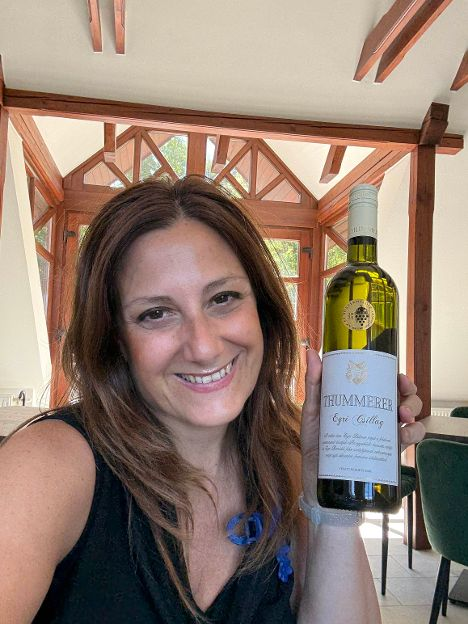
L’Egri Csillag 2025 (Királyleányka, Zenit, Sauvignon Blanc, Tramini) racconta il volto bianco di Eger, certamente meno conosciuto fuori dall’Ungheria rispetto all’Egri Bikavér. Freschezza e immediatezza ne definiscono il primo approccio, accompagnate da una componente aromatica capace di dare articolazione al sorso.
L’Egri Csillag Superior 2025 cambia passo. La materia acquista maggiore struttura e profondità senza perdere tensione. L’assaggio delle due etichette consente così di cogliere due differenti interpretazioni dell’anima bianca di Eger.
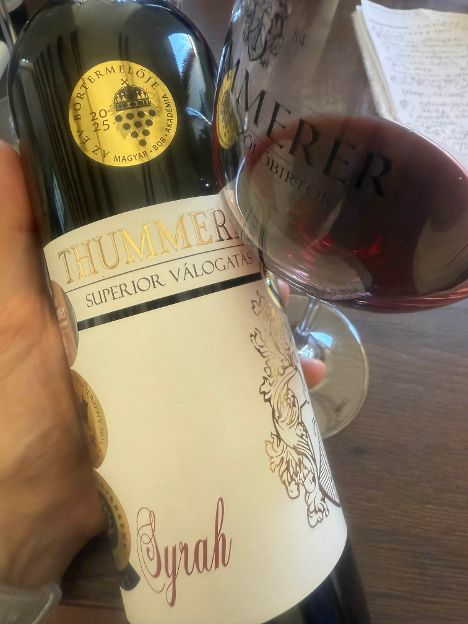
Con l’Egri Syrah Superior Válogatás 2021 (100% Syrah) si entra decisamente nel territorio dei rossi. Proveniente da Nagy-Eged, affina per venti mesi in barrique di secondo passaggio. Il frutto scuro incontra pepe e spezie, la struttura è importante, il tannino presente. I 15% vol. dichiarano concentrazione e materia senza compromettere l’equilibrio del sorso.
L’Egri Bikavér Grand Superior Nagy-Eged-dűlő 2021 (Kékfrankos, Cabernet Franc, Merlot, Syrah, Kadarka) restituisce nel bicchiere il progetto iniziato da Vilmos nel 2008. Le cinque varietà provengono da quel vigneto progettato pensando già alla loro futura convivenza. Raccolte e fermentate insieme, danno vita a un vino che affina diciotto mesi in legno: frutto scuro, spezie, struttura e una trama tannica ancora vitale.
Infine il Vili Papa Cuvée Superior 2021 (Cabernet Franc, Merlot, Cabernet Sauvignon), una delle etichette di riferimento della casa, prodotta soltanto nelle annate considerate migliori. Frutto maturo, profondità, struttura e tannini ne delineano un profilo importante, destinato all’evoluzione.
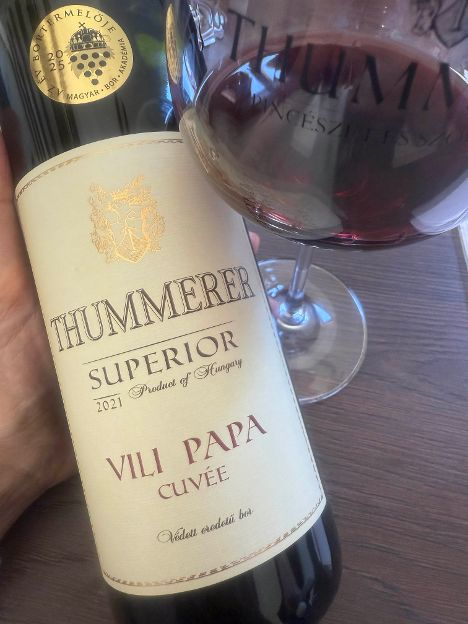
Ma è il nome a riportare inevitabilmente all’inizio della storia.Vili Papa era Vilmos Thummerer.
Ritorna allora quel volto nel quadro dell’ufficio e la somiglianza con Tamás. L’uomo che nel 1984 aveva cominciato senza una cantina da ereditare è diventato, una generazione dopo, il nome di uno dei vini prodotti dalla sua famiglia.
La continuità dei Thummerer, tuttavia, non sembra avere il carattere immobile della conservazione. La nuova generazione lavora sulle vigne, sperimenta e accompagna l’azienda in una fase diversa della sua storia, mantenendo saldo il legame con quella precedente.
Tamás conserva anche una particolare simpatia per l’Italia, dove torna da turista insieme alla famiglia. Un dettaglio apparentemente marginale, emerso quando ormai la riservatezza dei primi minuti ha lasciato spazio alla conversazione.
Resta soprattutto quella deviazione verso la vigna, nata quasi spontaneamente durante la degustazione.
Ed è forse lì che il ritratto nell’ufficio acquista il suo significato più autentico. Tamás somiglia molto a suo padre. Ma un’eredità non consiste nell’assomigliare a chi è venuto prima: consiste nel sapere che cosa farne.
In 1984, Hungary was still a People’s Republic. János Kádár had been governing the country for almost thirty years, and wine, like much of the economy, bore the consequences of a system that had replaced private ownership with cooperatives and state-run enterprises.
It is against this backdrop that the story of the Thummerer family in Eger begins.
Vilmos Thummerer did not inherit a winery. His father was a forester, and the family’s connection with the land came before its connection with the vine. After studying viticulture and fruit growing, Vilmos worked, gradually gathered the resources he needed to start a business of his own, and also cultivated cut flowers in greenhouses. Wine, therefore, was not the continuation of an existing family legacy, but a choice.
In 1984 came the first vineyards and two small cellars in Eger. These were the beginnings of an estate that, within just a few years, would need more space and would find it in Noszvaj, a few kilometres east of the city.
In 1991, the family purchased a property there, beneath which lay a large cellar carved by hand into the tuff. Around two thousand square metres of tunnels had been excavated between the late nineteenth and early twentieth centuries, when they served as the wine cellar of a large estate.
The move from Eger to Noszvaj was anything but comfortable. At first, Vilmos and his family lived in a caravan on the property. After spending a winter in those conditions, they temporarily moved into a dwelling carved into the rock while their house was being completed. These details seem remarkable today, especially when compared with what Thummerer has since become: one hundred hectares of privately owned vineyards and an underground cellar that, in 2004, was expanded by a further 2,200 square metres excavated into the tuff.
More importantly, however, they put the word “inheritance” into its proper perspective. Because what Tamás Thummerer eventually inherited had not, in turn, been inherited by his father.
Vilmos had built it.
In 1995, he was named Wine Producer of the Year in Hungary. In 2011, Thummerer received the title of Winery of the Year. In between came almost thirty years during which the family name became increasingly associated with Eger’s qualitative renaissance and, in particular, with its red wines.
Vilmos died in December 2021. Yet in the office at the Noszvaj winery, his face is still there, in a portrait. One only has to shift one’s gaze from the painting to his son Tamás to notice a striking resemblance, almost as though the passing of one generation to the next had preserved some of the same facial features.
And with Tamás, the story continues.
Today, Thummerer owns around one hundred hectares of vineyards in the Eger area, spread across plots differing in altitude, exposure and soil composition. Most are planted with red varieties: alongside Kékfrankos and Kadarka, both deeply rooted in the region’s winemaking identity, there are Cabernet Franc, Cabernet Sauvignon, Merlot, Pinot Noir and Syrah. The white varieties include Királyleányka, Chardonnay, Tramini, Ottonel Muskotály and Zenit.
This viticultural geography also reflects the evolution of Eger itself, where indigenous and international varieties have long coexisted, both contributing to the contemporary identity of the region.
Among the family’s vineyards, one name stands above the others: Nagy-Eged.
The hill overlooks Eger and is considered one of the region’s most prestigious vineyard sites. Here, in 2008, Vilmos Thummerer planted a vineyard conceived from the outset to produce an Egri Bikavér Grand Superior.
Kékfrankos, Cabernet Franc, Merlot, Syrah and Kadarka were planted in predetermined proportions, already anticipating the wine they would one day compose. It was an unusual choice, because it brought the moment of blending forward: no longer only in the cellar, among separately vinified wines, but directly into the vineyard itself.
In this case, the Bikavér was born even before the wine.
And it is among the vines that Tamás seems to find his most natural dimension.
Initially reserved, almost sparing in his answers, he gradually changes register as the conversation moves towards the more technical aspects of the tasting. Aromas, structure, grape varieties, the characteristics of the wines: the distance of those first few minutes begins to disappear. His explanations become more detailed, followed by observations, comparisons and technical insights. Eventually comes the suggestion that we leave the cellar and head for the vineyards.
It is not a scheduled part of the visit, nor a concession to the rituals of wine tourism, but rather the natural continuation of a conversation that, by then, has found its own language.
Among the rows of vines, Tamás talks about exposures, varieties and vineyard management with a different kind of involvement. It is one of those moments when a producer ends up revealing something about himself without ever speaking directly about himself: in the way he looks at a vine, points towards a particular plot, or explains the reasoning behind a decision.
The tasting reveals the same diversity.
The Egri Csillag 2025 (Királyleányka, Zenit, Sauvignon Blanc, Tramini) expresses Eger’s white-wine identity, certainly less familiar outside Hungary than Egri Bikavér. Freshness and immediacy define the first impression, accompanied by an aromatic component that gives greater complexity to the palate.
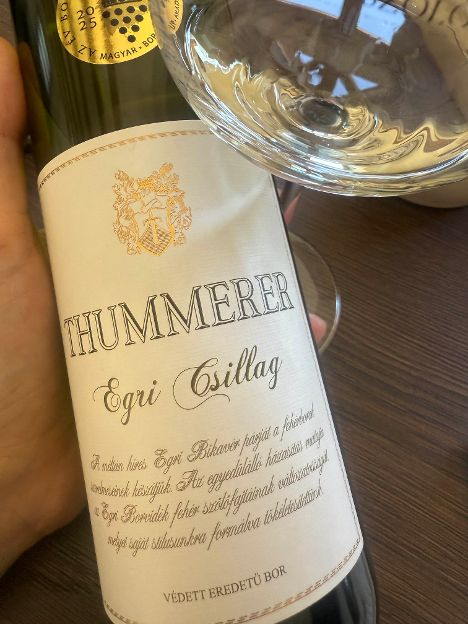
The Egri Csillag Superior 2025 moves into a different register. The wine gains structure and depth without losing tension. Tasting the two labels side by side therefore reveals two different interpretations of Eger’s white-wine character.
With the Egri Syrah Superior Válogatás 2021 (100% Syrah), the tasting moves decisively into red-wine territory. Sourced from Nagy-Eged, it spends twenty months in second-use barriques. Dark fruit meets pepper and spice; the structure is substantial and the tannins are clearly present. Its declared 15% alcohol reflects concentration and weight without compromising the overall balance of the wine.
The Egri Bikavér Grand Superior Nagy-Eged-dűlő 2021 (Kékfrankos, Cabernet Franc, Merlot, Syrah, Kadarka) brings into the glass the project Vilmos began in 2008. All five varieties come from the vineyard designed with their future coexistence already in mind. Harvested and fermented together, they produce a wine that spends eighteen months ageing in oak: dark fruit, spices, structure and a tannic texture that remains vibrant.
Finally, the Vili Papa Cuvée Superior 2021 (Cabernet Franc, Merlot, Cabernet Sauvignon) is one of the estate’s flagship wines, produced only in vintages considered worthy of it. Ripe fruit, depth, structure and tannins define a substantial wine built to evolve over time.
Yet it is the name that inevitably takes us back to the beginning of the story.
Vili Papa was Vilmos Thummerer.
The face in the portrait in the office comes back to mind, as does the resemblance to Tamás. The man who began in 1984 without a winery to inherit has, one generation later, become the name of one of the wines produced by his family.
The continuity of the Thummerer family, however, does not appear to be a static form of preservation. The new generation works in the vineyards, experiments and guides the estate into a different phase of its history, while maintaining a strong connection with the generation that came before.
Tamás also has a particular fondness for Italy, where he returns as a tourist with his family. An apparently minor detail, one that emerged only after the reserve of those first few minutes had given way to conversation.
What remains most vividly, however, is that spontaneous detour towards the vineyard during the tasting.
And perhaps it is there that the portrait in the office acquires its most authentic meaning.
Tamás looks very much like his father. But an inheritance is not about resembling those who came before us: it is about knowing what to do with what they left behind.